
Fire Door Fitting Norfolk | SAB Group
Fire Door Fitting with SAB Group in Wymondham, Norfolk
View More
Understand your legal responsibilities and keep your premises compliant with expert support on fire door regulations. SAB Group helps businesses, landlords, and responsible persons across Norwich and Norfolk navigate fire door legislation, standards, and compliance requirements with confidence.
Fire doors are a critical part of a building’s passive fire protection strategy. Their purpose is to slow the spread of fire and smoke, protect escape routes, support compartmentation, and buy time for evacuation and emergency response.
However, a fire door can only do this if it is correctly specified, properly installed, routinely inspected, and maintained in efficient working order. That is why fire door regulations matter: they exist to ensure that fire doors are not treated as ordinary doors, but as life safety systems that must perform under fire conditions.
For duty holders, understanding fire door regulations is essential not only for protecting people and property, but also for meeting statutory obligations and avoiding enforcement action.
Our Reviews
Fire door regulations form part of the wider UK fire safety framework. They place responsibility on building owners, employers, landlords, facilities managers, and other duty holders to make sure fire doors are fit for purpose and properly managed throughout their lifecycle.
This includes ensuring that fire doors are appropriate for their location, fitted with compatible fire-rated components, maintained in good repair, inspected at suitable intervals, and capable of performing their intended fire-resisting function.
For businesses and property managers across Norfolk, understanding fire door regulations is essential because compliance is not limited to installation alone. It extends to ongoing inspection, maintenance, repair, record keeping, and the broader fire safety management of the premises.
Understanding fire door regulations helps businesses make informed decisions about compliance, maintenance, procurement, and risk management.
It helps your business to:
Fire door compliance is not simply about having doors labelled as fire-rated. It is about ensuring the complete door assembly is suitable, correctly installed, maintained, and able to perform as intended in the event of a fire.
Several key pieces of legislation and guidance shape fire door requirements in the UK.
Regulatory Reform (Fire Safety) Order 2005
The Regulatory Reform (Fire Safety) Order 2005 is one of the main foundations of fire safety law in England and Wales. It places legal responsibility on the Responsible Person to implement and maintain appropriate fire safety measures within non-domestic premises and the common parts of residential buildings.
Although the Order does not set out every technical detail of fire doors, it creates the legal framework under which fire doors must be properly maintained, included within fire risk assessments, and kept in efficient working order and good repair.
Fire Safety (England) Regulations 2022
The Fire Safety (England) Regulations 2022 introduced more specific duties for responsible persons in certain residential buildings in England, particularly those over 11 metres in height.
These include requirements for regular checks of communal fire doors, self-closing devices, and annual checks of flat entrance doors on a best endeavours basis. The regulations also require residents to be given information about the importance of fire doors.
Building Safety Act 2022
The Building Safety Act 2022 introduced a wider building safety regime, particularly for higher-risk residential buildings. While it is not solely a fire door law, it increases accountability for building safety management and reinforces the need for important safety systems, including fire doors, to be properly documented, maintained, and managed throughout the building lifecycle.
Fire Safety Act 2021
The Fire Safety Act 2021 clarified that the scope of the Fire Safety Order includes a building’s structure, external walls, and flat entrance doors leading into common parts in multi-occupied residential buildings.
This matters because it brought flat entrance doors clearly into the fire safety regime, reinforcing the need for them to be considered in fire risk assessments and managed as part of the building’s fire safety measures.
Building Regulations 2010 – Approved Document B
Approved Document B provides the practical technical guidance used to meet fire safety requirements under the Building Regulations in England. It sets out where fire doors are required, the type of fire resistance they may need, and important guidance on areas such as self-closing devices, hardware, vision panels, smoke seals, and escape routes.
For both dwellings and non-dwellings, Approved Document B is one of the key documents used to guide correct fire door specification and installation.
Workplace (Health, Safety and Welfare) Regulations 1992
These regulations require workplace doors, including fire doors where relevant, to be maintained in efficient working order, good repair, and proper working condition. For employers, this adds another layer of legal expectation around maintaining door safety in the workplace.
In addition to legislation, fire door compliance relies heavily on technical standards and best-practice guidance.
Important examples include:
These standards help define how fire doors should be tested, specified, installed, signed, and maintained in practice.
Fire door ratings indicate the minimum length of time a fire door is designed to resist fire under test conditions.
Common examples include:
Where a suffix “s” is used, such as FD30s, this indicates the door is also intended to provide smoke control.
The required fire rating depends on the building type, fire strategy, location of the door, and the relevant risk assessment or design requirements.
A compliant fire door is not just a door leaf with a fire label. Compliance depends on the complete assembly and how it has been installed, maintained, and used.
A compliant fire door will generally require consideration of:
Even small defects or incompatible replacement parts can affect compliance and fire performance.
Responsibility usually falls to the Responsible Person, though in practice this may involve employers, building owners, landlords, managing agents, facilities managers, or others with control over the premises.
Their duties may include:
In higher-risk residential settings, further roles such as the Accountable Person may also apply under the building safety regime.
Fire safety legislation is primarily enforced by local Fire and Rescue Authorities. These authorities can inspect premises, review documentation, and take action where they find non-compliance.
Enforcement action may include:
Penalties can be severe and may include substantial fines and, in the most serious cases, imprisonment. This is why fire door compliance should be treated as a critical legal and safety obligation rather than an administrative exercise.
The most effective way to stay compliant is to treat fire door safety as an ongoing managed process rather than a one-off check.
This usually means:
A proactive approach reduces risk, improves fire safety performance, and makes compliance easier to demonstrate.
SAB Group supports clients across Norwich and Norfolk with practical fire door compliance services, including installation, inspections, maintenance, remedial works, and specialist guidance.
We understand that fire door regulations can be technical and difficult to interpret in practice. Our role is to help clients understand what matters, identify issues early, and take the right actions to keep their buildings safe and compliant.
Whether you need support understanding your duties, inspecting existing fire doors, or addressing identified defects, we provide practical, standards-led fire door services tailored to your premises.
Get in touchSAB Group helps businesses, landlords, and property managers navigate fire door regulations with confidence through expert fire door installation, inspection, maintenance, and remedial support.
Get in touch with SAB Group today to discuss your fire door compliance requirements.
Case studies
Want the same level of commercial property protection?
Fire Door Fitting with SAB Group in Wymondham, Norfolk
View More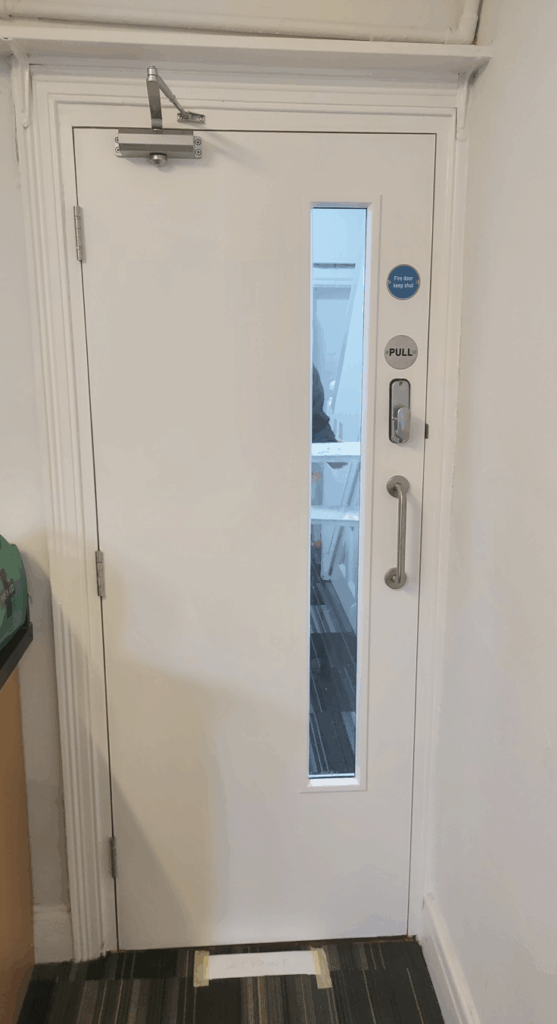
We take pride in delivering high-quality fire door solutions that make a real difference. From installation and inspections to maintenance and remedial works, our skilled team ensures every project is completed to the highest standard.
We’re here to help! Get in touch today – let's make your premises compliant

Call Us

Email Us

Address
Head Office:
SAB Group, Ground Floor, Vanquish House, Wellesley Road, Tharston, Norwich, NR15 2PD.
Workshop:
Richmond Close, Honingham, Norwich, Norfolk. NR9 5BP
